New York runs two air toxics monitoring stations. One sits in the Bronx. The other is here in Rochester, quietly logging what we breathe while almost nobody looks at the output.
Most of my neighbors went looking for that data exactly once. June 2023, the afternoon the sun turned into an orange disc you could stare straight at. Smoke from fires hundreds of miles north had parked itself over the region, and people who had never once thought about an air quality reading suddenly wanted one and had no idea what it meant when they found it.
So let me make the invisible part visible. Air quality here isn’t one condition you memorize. It’s a calendar. The pollutant changes with the month, and whatever makes your eyes itch in May usually isn’t what the index is measuring. Our spot on the south shore of Lake Ontario at the mouth of the Genesee River, a spot that shapes our weather all year, drives more of this than most people living here realize.
I can’t give you today’s reading. No static page can. What I can hand you is the part nobody explains: why the number behaves the way it does here, and which levers actually work once it climbs.
TL;DR Quick Answers
Air Quality Rochester NY
Rochester's air is cleaner than most of the country on paper and harder to live with than almost anywhere on pollen. Our metro earned passing grades on all three measures in the 2026 State of the Air report, and we rank fifth nationally for pollen allergies. Both are true at the same time.
Two pollutants drive the index. Ground-level ozone from April through September, and fine particulate matter all twelve months.
Pollen isn't an AQI pollutant. That's why a clean reading and a miserable morning land on the same day.
Canadian wildfire smoke is the real spike risk. It arrives before you smell it and lingers after the haze clears, so follow the forecast rather than the sky.
Winter is the blind spot. Cold, still nights trap wood smoke near the ground, and almost nobody here checks the index in January.
The number you control is indoors. Close the envelope, close the fresh air intake, run MERV 13 with the fan continuous, and skip the cooking, candles, and vacuuming.
Top Takeaways
Ozone drives the index in the warm months and fine particulate matter drives it year round, and the two behave nothing alike.
Pollen isn’t an AQI pollutant, which is why a clean reading and terrible allergy symptoms show up on the same morning.
Ozone peaks in late afternoon and early evening, so mornings are the better window for summer exercise.
Canadian smoke arrives before you smell it and lingers after the haze clears. Follow the forecast, not the sky.
Indoors, work in order: close the envelope, close the fresh air intake, run MERV 13 with the fan continuous, stop adding particles.
What the AQI Actually Measures in Rochester
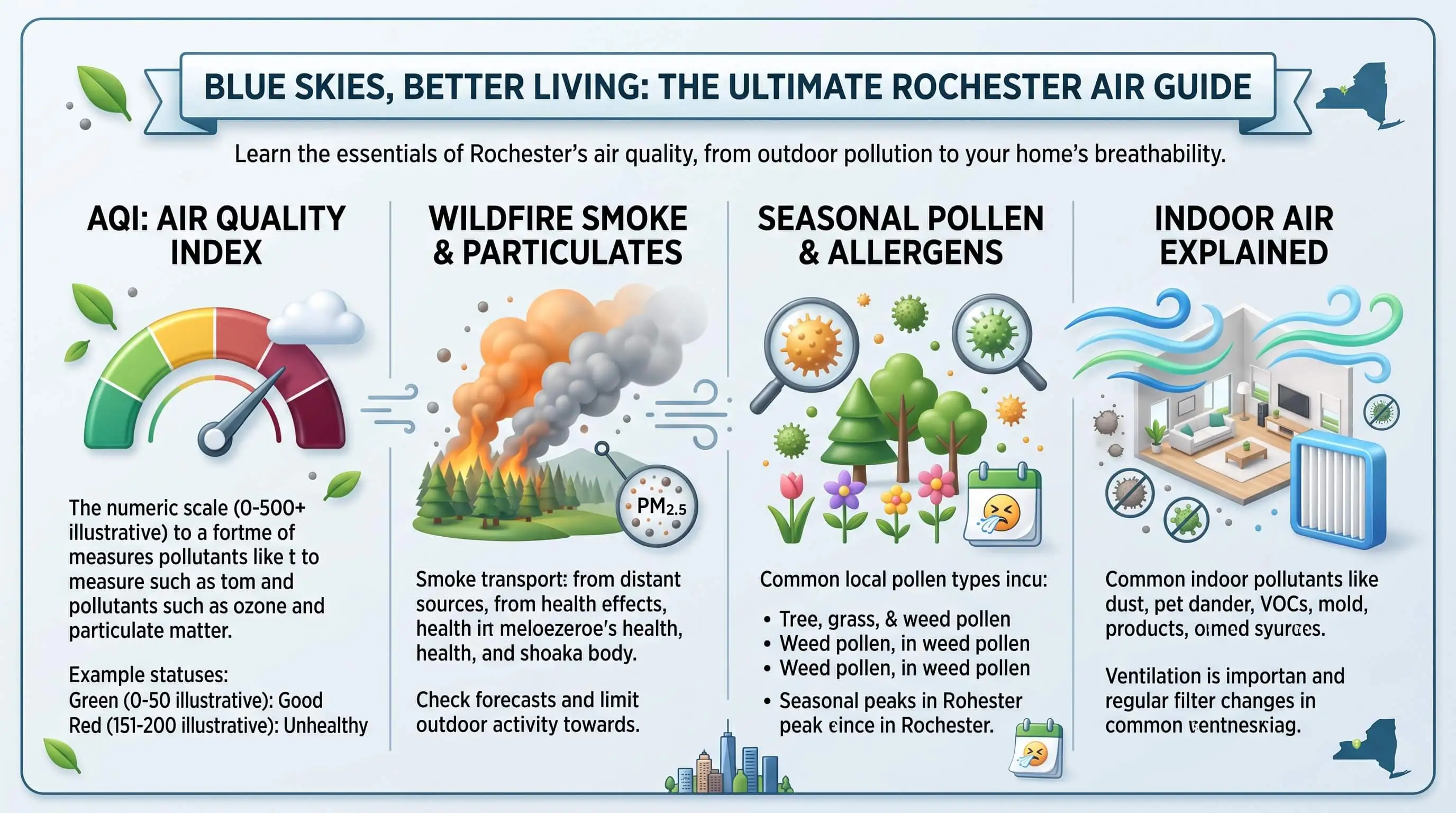
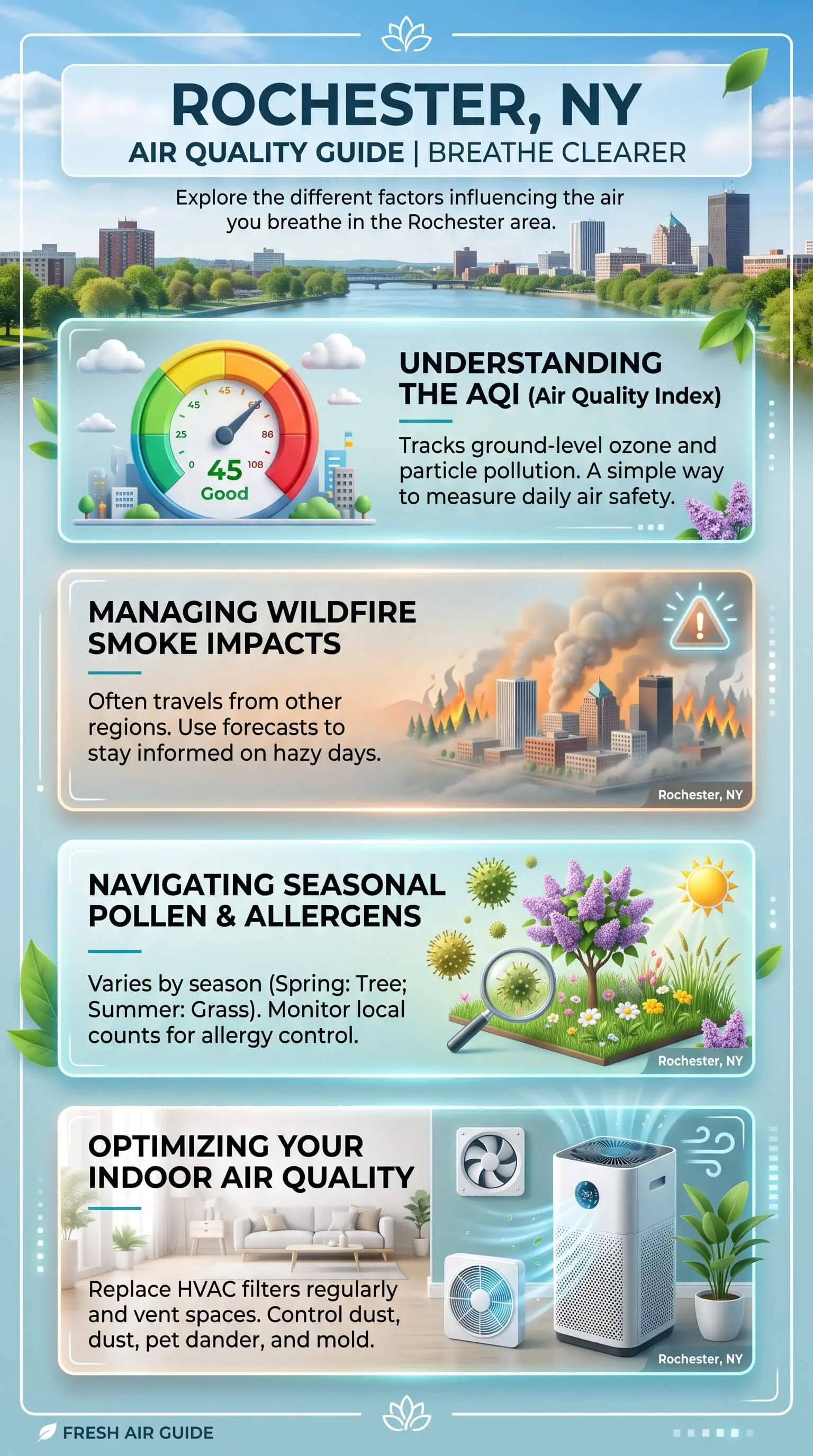
The Air Quality Index runs 0 to 500, turning pollutant concentrations into one health-referenced number. At or below 100, conditions are generally considered satisfactory. Past 100 the air turns unhealthy for sensitive groups first, then for everybody.
Two pollutants drive nearly every reading we get: fine particulate matter, which you’ll see written as PM2.5, and ground-level ozone. They behave nothing alike. Ozone is a colorless gas that forms when sunlight cooks vehicle exhaust and industrial emissions, much of ours drifting in from out of state. Particulates are physical specks small enough to slip past the defenses your body built to stop bigger things.
These aren’t estimates. New York measures air pollutants at more than 50 sites statewide. For forecasting, Monroe County sits inside the Eastern Lake Ontario advisory region with Jefferson, Oswego, Wayne, and northern Cayuga counties, which is why an advisory on the local news covers far more ground than the city limits. The importance of properly sizing your AC unit also comes into play indoors, where balanced airflow helps the system circulate and filter air effectively.
The Rochester Air Quality Calendar
Spring: the pollen the index can’t see
This one trips up nearly everybody, every year. Tree pollen shows up, symptoms show up with it, you check the index braced for an ugly number and get a clean one. So you decide the index is broken. It isn’t. Pollen simply isn’t a pollutant the AQI tracks. A good reading and a miserable morning can land on the same day, and neither is lying to you.
Summer: ozone that peaks late in the day
The state forecasts ozone from April through September, and fine particles all twelve months. Ozone needs heat and strong sun. It builds through the afternoon and tops out early in the evening, not at noon, which means a July run after work puts you outside in the worst window of the day. Move it to the morning. Costs you nothing.
Late summer and fall: ragweed plus the smoke tail
Weed pollen season lands right when kids head back to school and colds start circulating, so symptoms get hard to sort out. Here’s the tell: itchiness. Itchy eyes and nose point to allergy, not infection. This stretch also sits inside the Canadian fire season, so a smoke episode stays on the table well into September.
Winter: the season nobody checks
Cold, still nights create inversions that cap the valley and trap wood smoke and vehicle particulate near the ground. Particle forecasts run year round for exactly this reason. Almost nobody here checks the index in January. Easiest gap in your year to close.
Why Canadian Wildfire Smoke Reaches Rochester
Smoke from boreal fires rides the upper atmosphere for hundreds of miles, then mixes down over the Great Lakes when the pattern lets it. That’s how we post hazardous readings with nothing burning near us.
Learn the signature and you’ll stay ahead of it. The number climbs before you smell a thing, and it stays elevated after the haze clears, which is exactly when people throw their windows open. In July 2026 state forecasters put the Eastern Lake Ontario region, Monroe County included, at Very Unhealthy for fine particulate matter off Canadian fires. Our own wildfire risk is low. Somebody else’s fires reach us anyway, and that’s the part worth planning around.
Checking Today’s Number Without Overreacting
Forecasters issue an advisory when they expect ozone or PM2.5 to push the index past 100. Under that, carry on. Between 101 and 150, kids, adults over 65, and anyone with heart or lung disease should ease off outdoor exertion. Above 150 that goes for everyone. Above 200, county guidance calls for cancelling competitive sports and intense outdoor events.
This page can’t show you a live value, so pull up a real-time air quality index map for Rochester NY or the state forecast when you want the current picture.
One caution saves a lot of unnecessary panic. Regulatory monitors and cheap consumer sensors are not the same instrument. State data meets federal standards and reports averages over a defined period. Plenty of app readings are snapshots. They swing hard, and they don’t compare cleanly to the index. If an app screams 180 and the state forecast says moderate, trust the state.
What the Outdoor Number Does to the Air Inside Your House
PM2.5 gets indoors easily. Within hours your indoor levels track the outdoor ones unless something stops them. Four things can, and all four sit under your control.
Start with the building envelope, because it’s free. Closed windows, closed doors, closed fireplace damper. Slowing infiltration is the biggest move you’ve got, and it costs nothing but a walk around the house.
Filtration comes next. The importance of filtration becomes especially clear during smoke events, when federal guidance points to a MERV 13 filter, or the highest rating your system handles without choking airflow, with the fan running continuously so air keeps moving through the media. A filter that isn’t moving air isn’t filtering anything.
Then your ventilation setting. This is where I see people get it backwards most often. If your system has a fresh air intake, close it while the smoke is outside. Recirculate is right during the event. Air the house out once the forecast improves, not before.
Source control multiplies all of it, free. Skip the candles, the incense, the frying. Don’t vacuum unless the machine has a HEPA filter, since a standard vacuum mostly relocates fine particles around the room you’re trying to clean.
What I Change at Home When the Number Climbs
The night before a forecast advisory, I close the house up and flip the thermostat fan from auto to on. Fresh filter goes in, because a partly loaded one has less capacity left for what’s coming. Attic insulation installation can also help tighten the home’s envelope and reduce unwanted outdoor air infiltration. I keep a spare in the closet from May through September rather than hunting one down mid-event, a losing game once the neighbors have the same idea.
During the event I cook less and I don’t vacuum. My mistake the first year was opening up too early. Haze cleared, sky looked normal, I opened the windows, and the reading was still sitting high. Now I wait on the forecast, not the view.
Afterward I pull the filter and actually look at it. Through the worst weeks I’ve watched filters load noticeably faster than in an average month, though how much faster depends on your system and how long the episode ran.
“People call during a smoke event asking about the outdoor number, and I get why, but that’s the one they can’t touch. The one they can touch is inside the house. Close the fresh air intake, put in a MERV 13, leave the fan running, and you’ve done more in an afternoon than anything else on the table. I’ve walked into houses mid-event where every window was shut tight and the fan had barely run all day.”
7 Essential Resources
1. AirNow AQI Basics. https://www.airnow.gov/aqi/aqi-basics/ The federal explainer for the scale and its six categories, plus conditions by ZIP code.
2. EPA, Reduce Your Smoke Exposure. https://www.epa.gov/wildfires/reduce-your-smoke-exposure Official indoor guidance during a smoke event, including the MERV 13 and recirculate recommendations.
3. NYSDEC Air Quality Index Forecast and Current Observations. https://dec.ny.gov/environmental-protection/air-quality/air-quality-index-forecast-current-observations State forecasts by advisory region, plus the county list covering Monroe.
4. National Weather Service, Air Quality Index. https://www.weather.gov/safety/airquality-aqindex How the index relates to the five Clean Air Act pollutants.
5. NOAA Hazard Mapping System Fire and Smoke Product. https://www.ospo.noaa.gov/products/land/hms.html Satellite-analyzed smoke plume extent across North America, updated daily. This is how you see smoke coming before it gets here.
6. Monroe County Environmental Health, Outdoor Air. https://www.monroecounty.gov/eh-outdoorair County guidance banded by AQI range, including the thresholds for cancelling outdoor events.
7. New York State Department of Health, Asthma Data. https://www.health.ny.gov/statistics/environmental/public_health_tracking/health/asthma.htm County and regional asthma emergency department and hospitalization data.
Federal, state, and Monroe County resources all point to the same practical approach: check current AQI conditions, prepare for wildfire smoke, and manage indoor filtration carefully. MERV 11 pleated HVAC furnace air filters can support that strategy by capturing a broader range of airborne particles when they are properly matched to the system.
3 Statistics Worth Knowing
1. During the June 2023 smoke event, asthma-associated emergency department visits across the Eastern Lake Ontario region, Monroe County included, climbed 179.1 percent on June 7 against the June 1 to 5 baseline. No other region in the state saw a bigger jump (CDC, MMWR, 2023). https://www.cdc.gov/mmwr/volumes/72/wr/mm7234a6.htm
2. Rochester ranks fifth on the 2026 Allergy Capitals report, which grades the 100 most populous U.S. metro areas on pollen scores, medication use, and access to specialists (Asthma and Allergy Foundation of America, 2026). https://aafa.org/asthma-allergy-research/allergy-capitals/
3. The Rochester-Batavia-Seneca Falls metro area earned passing grades on all three pollution measures in the 2026 State of the Air report, ranking 125th worst nationally for ozone (American Lung Association, 2026, using 2022 to 2024 data). https://www.lung.org/research/sota/city-rankings
Final Thoughts and Opinion
Set those last two statistics next to each other and you have the most useful thing I can tell you about air quality in Rochester NY. By official measures our air is clean. By the pollen measures we’re one of the hardest places in the country to live with seasonal allergies. A high quality filter can help reduce the amount of pollen and other airborne particles circulating indoors. Both true at once, which explains why so many people here walk around convinced the index is lying.
My read, and I’ll own it as opinion: the smoke years quietly moved the goalposts on normal. A city with good baseline air now gets a handful of days worse than anything most of us had experienced. Those days barely move an annual average. They’re also the days that put our neighbors in the emergency room.
You can’t do a thing about the outdoor number. The indoor one is almost entirely yours.
Frequently Asked Questions
Is the air quality in Rochester NY bad?
By national standards, no. Our metro area earned passing grades on all three measures in the 2026 State of the Air report. The catch: a handful of wildfire smoke days each year push readings into unhealthy territory or worse, and those spikes carry real consequences even when the annual picture looks fine.
What AQI level is considered safe?
At or below 100, conditions are generally considered satisfactory. Between 101 and 150, sensitive groups should cut back on outdoor exertion. Above 150, everybody should. New York issues an advisory when forecasters expect the index to top 100 for either pollutant.
Why does Rochester get wildfire smoke when there are no fires nearby?
Smoke from Canadian boreal fires travels the upper atmosphere for hundreds of miles, then mixes down over the Great Lakes. Monroe County has low wildfire risk of its own, but distant fires have reached us repeatedly.
Does closing the windows actually help during a smoke event?
Yes, and do it first. Fine particles work indoors within hours. Closing your windows, doors, fireplace damper, and any fresh air intake meaningfully cuts how much outdoor air ends up inside with you.
What MERV rating should I use during a smoke event?
Federal guidance points to MERV 13, or the highest rating your system handles without restricting airflow. Top air filters can help improve particle capture, but running the fan continuously matters as much as the rating, because the media only works on air that actually passes through it.
Next Steps
Two things are worth doing before the next advisory instead of during it.
First, bookmark a live index source and sign up for the state air quality alerts. Email, text, or app. The forecast finds you instead of waiting on you to remember.
Second, go read the size and MERV rating printed on your current filter and write it down somewhere you’ll find it. When an advisory lands and you want to upgrade, those thirty seconds are the difference between fixing it that afternoon and waiting a week on the right part. Find your fresh air intake control while you’re down there.
You’re the one in your house who notices this stuff and does something about it. Indoor air quality testing can give you clearer information about what’s actually happening inside your home. That job gets a lot easier when you have the information before you need it.