Here is something that might surprise you. A 14x30x1 filter is not actually 14 inches by 30 inches by 1 inch. It is built slightly smaller on purpose, so it slides cleanly into a slot sized to those rounded numbers. That small gap between what the label says and what the tape measure shows sends thousands of homeowners back to the store with the wrong filter every week.
Don't take your indoor air for granted. After manufacturing filters for over a decade and helping millions of families, we've watched this exact mix-up happen in home after home. In the next five minutes, you'll know that the 14x30x1 HVAC home air filter is the right size for your system, and you'll have the confidence to order the right pack the first time.
TL;DR Quick Answers
14x30x1 HVAC home air filter
A 14x30x1 HVAC home air filter is a 1-inch-thick residential filter with a nominal size of 14" x 30" x 1" and an actual manufactured size of approximately 13 7/8" x 29 7/8" x 3/4". It slides into the return grille, air handler, or filter cabinet of central HVAC systems built for that size slot.
Key facts at a glance:
Nominal size: 14" x 30" x 1"
Actual size: approximately 13 7/8" x 29 7/8" x 3/4"
Common MERV ratings: MERV 8 (standard), MERV 11 (pet dander and mild allergies), MERV 13 (smoke, bacteria, fine allergens)
Replacement cadence: every 60 to 90 days under normal use. Every 6 weeks for allergy sufferers or homes with pets
Availability: less-stocked at big-box stores but manufactured daily at Filterbuy U.S. facilities
The Filterbuy insight most homeowners miss:
The size printed on your old filter is not always the size your HVAC system was built to take. A previous owner or contractor may have forced the wrong filter into the slot. To confirm 14x30x1 is your size, measure the interior of the filter slot itself with a tape measure. If it falls within 13.5" to 14" wide, 29.5" to 30" long, and 0.75" to 1" deep, 14x30x1 is correct.
Top Takeaways
The 14x30x1 printed on a filter frame is the nominal size. The actual manufactured size is about 13 7/8" x 29 7/8" x 3/4".
Always measure the filter slot itself, not the old filter. A previous owner may have installed the wrong size for years.
Edge gaps, a bowed frame, and dust on the clean side of the old filter are the three reliable signs of a prior mis-size causing bypass.
14x30x1 filters come in MERV 8, MERV 11, MERV 13, and odor-eliminator versions. The right choice depends on who lives in the home, not on how old the system is.
Replace a 1-inch 14x30x1 every 60 to 90 days under normal conditions. Shorten that window during heavy cooling runtime, or if you have pets or allergy sufferers at home.
Why Filter Size Accuracy Matters More Than Most Homeowners Realize
A loose filter is not a small problem. When a filter sits even half an inch short of the slot, air finds the easiest path and goes around the filter instead of through it. That is called bypass, and it is exactly the kind of hidden air quality issue we want to make visible for you.
Every particle riding in that bypass air lands directly on the evaporator coil, the blower wheel, and the return ducts. Dust, pollen, pet dander, drywall grit from a kitchen remodel, all of it. Over months, the coil runs hot, the blower motor strains, and the electric bill climbs without an obvious cause. We've traced a lot of premature HVAC failures back to a single wrong air filter decision that was repeated for a season or two.
Verifying the size before you order is the easiest HVAC maintenance step on the list. It costs nothing, takes five minutes, and protects two of your greatest assets, which are your family's health and your HVAC system.
Nominal Size vs Actual Size: The 14x30x1 Confusion
Every residential filter size in the United States uses two numbers. The label is called the nominal size, and it reads something like 14x30x1, 16x25x1, or 20x25x4. The actual size is what we manufacture, and it is always a hair smaller than the label.
For a 14x30x1, here is how the two numbers break down:
Nominal size: 14" x 30" x 1"
Actual size: 13 7/8" x 29 7/8" x 3/4"
The slot in your HVAC system is sized to the nominal dimensions. The filter is built a quarter inch smaller so it slides in and out without binding or tearing the media. If the old filter prints 14x30x1, that is the size you order. Every brand rounds the same way, and every brand builds to the same standard.
Here is where it gets reassuring for homeowners choosing a pleated furnace filter. A previous owner, or a contractor who was working fast, may have forced the wrong filter into your slot at some point. When that happens, the number on the old filter stops telling you the truth about your system. The only number that always tells you the truth is the slot itself.
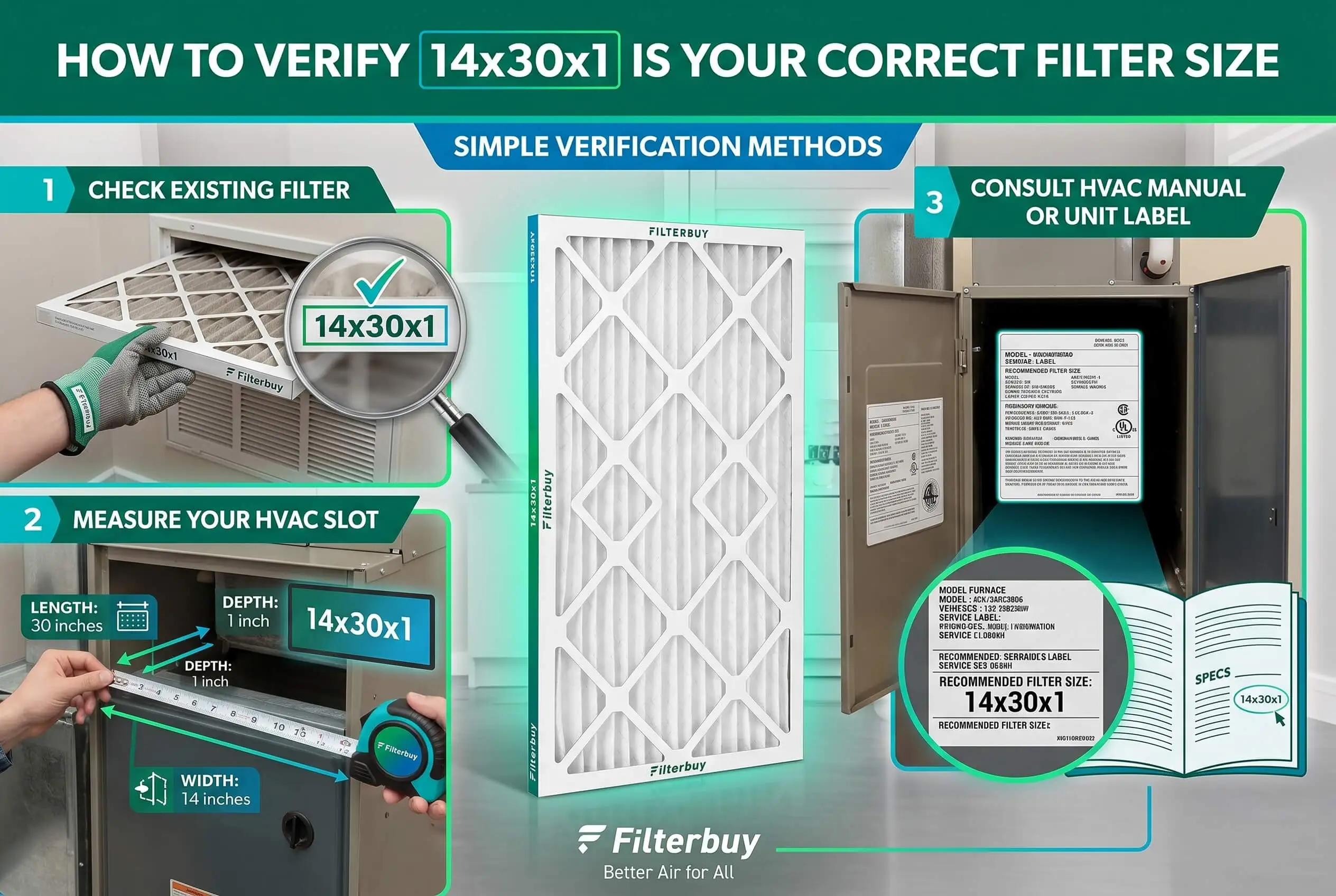
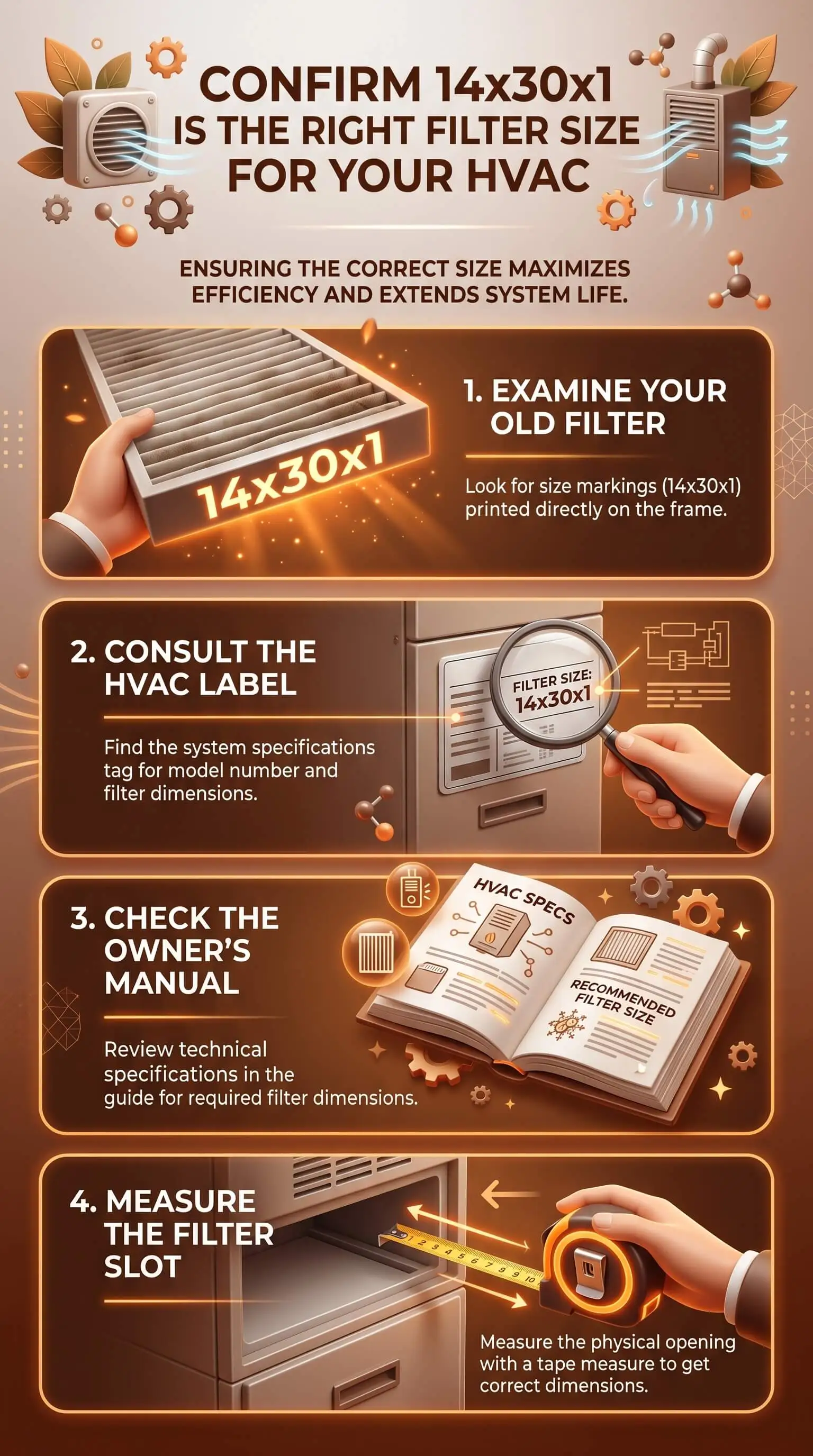
How to Verify Your HVAC Actually Takes a 14x30x1
Grab a tape measure and work through these seven steps. The whole check takes under five minutes.
Turn off the HVAC system at the thermostat before you pull anything. This keeps the blower from sucking loose debris onto the coil while the slot is open.
Locate the filter slot. On most central systems, you'll find it in one of three places: inside the return grille on a wall or ceiling, inside the air handler behind a small door, or in a dedicated filter cabinet next to the furnace.
Slide out the current filter. Write down the three numbers printed on the frame. That is the nominal size the last person who replaced it believed was correct.
Measure the slot, not the old filter. Press the tape against all four interior walls of the housing. Record length, width, and depth. This is the step almost everyone skips.
Compare your slot measurements against the 14x30x1 range: length 29.5" to 30", width 13.5" to 14", depth 0.75" to 1". If all three fall in those ranges, 14x30x1 is your size.
Inspect the old filter before you toss it. Edge gaps, a bowed or collapsed frame, and heavy dust on the clean side all point to a prior mis-size that has been leaking air for months.
Slide the new 14x30x1 into the slot with the airflow arrow pointing toward the furnace or air handler. Close the door, turn the thermostat back on, and you're done.
"14x30x1 has a reputation for being a rare size, and that reputation is almost entirely a retail story. Big-box stores keep the eight or ten best-selling sizes on their shelves and call everything else a special order. We make 14x30x1 every single day at our Alabama, Pennsylvania, Texas, and Utah facilities. What we actually see hurting homeowners is not availability. It is the moment someone realizes the old filter was the wrong size all along and nobody caught it. Measure the slot once. That five-minute check is the difference between a system that runs clean for fifteen years and one that dies at nine."
7 Essential Resources
Verifying size is step one. These seven resources cover the decisions that come right after: MERV rating, replacement timing, energy impact, and the research behind indoor air quality. Every link goes to a primary .gov or .org source.
1. Confirm MERV Is the Right Way to Compare Filters
Before you order any 14x30x1, it helps to know what MERV actually measures. It captures particle performance across the 0.3 to 10 micron range, which is why proprietary retail ratings like FPR and MPR don't compare cleanly across brands. The EPA's breakdown is the clearest one we've found.
Source: EPA: What Is a MERV Rating?
2. Match the Filter to the System You Actually Have
The EPA's residential air cleaner guide walks through how to pick the highest-rated filter your system can accept without starving airflow. For most homes, the right answer is rarely the highest MERV on the shelf, and this page explains why.
Source: EPA: Guide to Air Cleaners in the Home
3. Replace the Filter on a Schedule That Matches Real Use
The Department of Energy's AC maintenance page is the baseline reference for replacement timing in active cooling conditions. It also covers what happens to the evaporator coil when airflow drops. For a 14x30x1, this is the document we point homeowners to first.
Source: U.S. Department of Energy: Air Conditioner Maintenance
4. Understand Why Indoor Air Quality Is Worth the Effort
Most homeowners verifying a filter size are really trying to protect somebody's breathing. A child with allergies. An older parent. A partner with asthma. The EPA's indoor air quality page lays out the health stakes in plain language.
Source: EPA: Introduction to Indoor Air Quality
5. Cut Heating and Cooling Costs Starting With the Filter
ENERGY STAR calls out the monthly filter check as the highest-return HVAC maintenance step a homeowner can take. Their page is the cleanest starting point for anyone planning a year of 14x30x1 replacements.
Source: ENERGY STAR: Heat and Cool Efficiently
6. Know the Standard Behind Every MERV Number
ASHRAE Standard 52.2 is the test method that produces every MERV rating on every 14x30x1 on the market. Knowing the standard helps explain why two filters both labeled MERV 8 can perform noticeably differently in the same system.
Source: ASHRAE: Standards and Guidelines
7. Layer Filtration With Broader Indoor Air Strategies
NIEHS pulls together the research on indoor air pollutants in homes and schools. It is the evidence base that helps a homeowner decide whether MERV 11 or MERV 13 is the right target for their specific 14x30x1.
Source: National Institute of Environmental Health Sciences: Indoor Air
Supporting Statistics
These numbers come directly from federal agencies and the largest indoor air research organizations in the country. No aggregators. Each stat is followed by what we've actually seen on the manufacturing floor and in customer service after more than a decade of making filters.
Statistic 1: Heating and Cooling Is Roughly Half of Your Home's Energy Use
Stat: Nearly half of the energy used in a typical U.S. home goes to heating and cooling, according to ENERGY STAR. That is why a clean, correctly sized filter has such a big effect on monthly utility bills.
What we've seen: In our customer service data, the single most common cause of an unexpected summer bill spike is not the outdoor unit, the thermostat, or a duct leak. It is a 1-inch filter that has been in place for five months in an actively cooling Florida or Texas home. A correctly sized 14x30x1, replaced on schedule, pays for itself inside one cooling season.
Source: ENERGY STAR: Heating and Cooling
Statistic 2: Americans Spend About 90% of Their Time Indoors
Stat: The EPA reports that Americans spend approximately 90% of their time indoors, where concentrations of some pollutants are often 2 to 5 times higher than typical outdoor levels.
What we've seen: That 90% figure is the whole case for getting 14x30x1 right. The filter is not a cosmetic upgrade. For nine-tenths of your family's day, it is the only barrier between their lungs and whatever the return duct is pulling in. After serving more than two million households, we've learned that homeowners who understand this number almost never go back to guessing at sizes.
Source: EPA: Report on the Environment, Indoor Air Quality
Statistic 3: Most Residential HVAC Systems Can Handle MERV 13
Stat: According to the EPA, most furnaces and HVAC systems can accept a MERV 13 filter without equipment problems, as long as the filter is replaced on schedule. MERV 13 captures at least 50% of the smallest particles tested under ASHRAE 52.2.
What we've seen: We've shipped 14x30x1 MERV 13 into ten-year-old systems that ran flawlessly and into brand-new variable-speed systems that choked within a week. The age of the equipment is rarely the deciding factor. What matters is the condition of the return ductwork and whether the filter gets swapped every 60 days instead of every 180. Size first. MERV second.
Source: EPA: What Kind of Filter Should I Use in My Home HVAC System?
Final Thoughts and Opinion
Measuring the slot with a tape measure, instead of trusting whatever number is printed on the old filter, is the single habit that separates homeowners who replace clean filters from the ones who eventually replace a compressor. It takes five minutes and costs nothing.
Here is another thing worth saying out loud. 14x30x1 is not a rare size. It is a less-stocked size at big-box retailers because those shelves are built around the eight or ten most popular dimensions. That is a retail inventory decision, and it has nothing to do with what your home actually needs or properly sizing your AC unit. Every 14x30x1 from Filterbuy is made daily at our U.S. manufacturing facilities, because no family should have to force the wrong filter into the right slot just to match what a hardware store happened to stock that week.
Frequently Asked Questions
Q: What are the actual dimensions of a 14x30x1 filter?
A: Nominal size: 14" x 30" x 1". Actual size: about 13 7/8" x 29 7/8" x 3/4". The industry rounds to nominal dimensions so that every brand's filter fits the same slot without binding.
Q: How do I know if my HVAC system needs a 14x30x1?
A: Measure the filter slot with a tape measure. If the interior of the slot falls within 13.5"-14" wide, 29.5"-30" long, and 0.75"-1" deep, 14x30x1 is your size. Don't rely on the size printed on an existing filter by itself. It may have been forced into the wrong slot by a previous owner or contractor.
Q: Can I use a slightly smaller filter if I can't find 14x30x1?
A: No. A smaller filter lets air bypass around the edges, which sends unfiltered dust straight onto the evaporator coil and into the blower. Bypass hurts both air quality and HVAC efficiency. Order the correct 14x30x1. It is widely available online, even when big-box stores don't stock it.
Q: What MERV rating should a 14x30x1 be?
A: For most homes, MERV 8 through MERV 13 is the useful range. MERV 8 handles everyday dust and pollen. MERV 11 captures pet dander and finer particles. MERV 13 catches smoke, bacteria, and smaller allergens, and the EPA recommends MERV 13 or as high as your system can accept.
Q: How often should I replace a 14x30x1 filter?
A: Every 60 to 90 days for most homes. Every six weeks if someone in the home has allergies. Every two months with pets. During heavy cooling months, especially in the South, check it monthly and replace it when it looks loaded.
Q: Why does the size printed on the frame not match my tape measure?
A: Filter sizes are labeled using nominal dimensions, which round up from the actual build size. A 14x30x1 is built slightly smaller than 14" x 30" x 1" on purpose, so it slides in and out of the slot cleanly. That small gap is standardized across the industry.
Ready to Order Your 14x30x1?
You're the hero of your household when it comes to maintaining clean air. Now that the slot is verified, the rest is simple. Filterbuy makes 14x30x1 daily in American facilities in MERV 8, MERV 11, MERV 13, and odor-eliminator versions. Orders ship in 24 hours, and a 6-pack covers about a year of replacements for most homes.
Shop Filterbuy 14x30x1 Air Filters, Made in the USA
Better air for you, your home, and your HVAC system. Every filter change is a small move that protects the people under your roof, and with the right size in your cart, that move takes five minutes.